AI tools have become part of the daily work of many freelancers, from drafting first versions to generating ideas and reviewing code. The question is no longer whether to use them, but how to use them to raise the quality of your work and your value to clients instead of being pushed into a race on price.
In this article we look at what the available numbers say, the fastest-growing and most in-demand skills according to Upwork, what Arab platforms list, and a practical plan for your first 30 days.
What do the numbers say?
According to Upwork’s Future Workforce Index 2026, freelancers who use AI on the marketplace earn on average 34% more per hour than those who do not. The report also shows a pattern worth noticing:
- Simple AI and creative-production contracts grew about 90% year over year, but earnings per contract fell 13%.
- More complex work where freelancers combine AI with domain expertise saw earnings rise 45%.
- AI-augmented professional services grew 72% in volume, with earnings up 22%.
An illustrative example: if you earn $20 an hour, a 34% increase means about $26.80, or $6.80 more per hour. This is arithmetic to explain the percentage, not a figure from the report; Upwork’s recent reports do not publish average hourly rates in dollars.
These figures come from a single platform and reflect one market, so treat them as a sign of direction, not a rule for everyone.
The fastest-growing skills according to Upwork
Upwork’s In-Demand Skills 2026 report tracks growth in freelancer earnings per skill in 2025 versus 2024, for skills with more than $100,000 in aggregate earnings in their category and demand originating in the United States. Highlights:
| Skill | Category | Year-over-year growth |
|---|---|---|
| AI video generation and editing | Design & Creative | 329% |
| AI integration | Coding & Web Development | 178% |
| AI data annotation and labeling | Data Science & Analytics | 154% |
| Ecommerce management | Customer Service & Admin Support | 130% |
| AI image generation and editing | Design & Creative | 95% |
| AI chatbot development | Coding & Web Development | 71% |
| Social media strategy | Sales & Marketing | 36% |
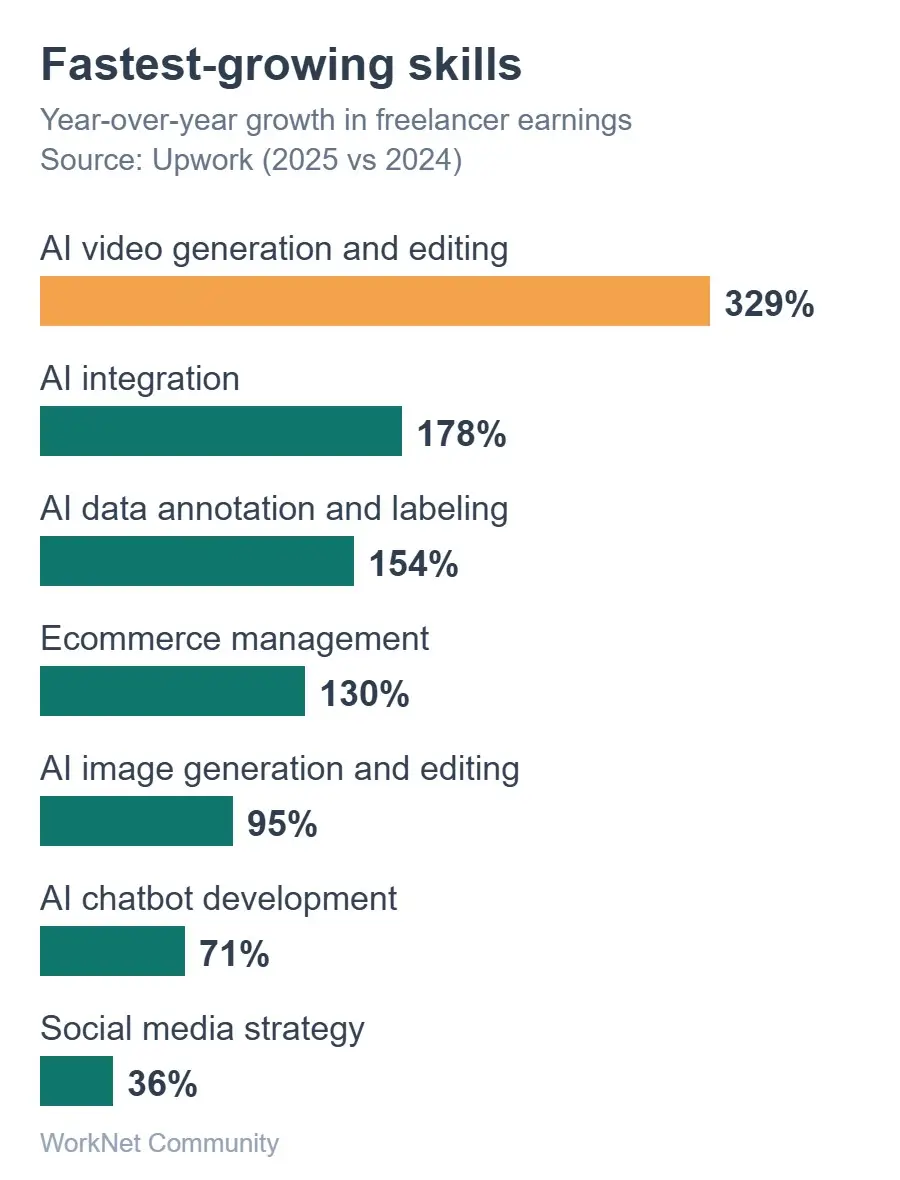
Overall, skills that explicitly reference AI grew 109% year over year.
Skills in demand in the Arab market
There are no Arab reports on the scale of Upwork’s, but two sources give a rough picture of demand in the region:
- Mostaql: its projects page lists these categories: software and web development, digital marketing, graphic design, audio production, video editing, writing and translation, and editing and proofreading (official site).
- Bayt.com survey (2022): 1,764 respondents from Arab countries, reported by Arab News in an opinion column in February 2023. It named digital marketing, information technology, customer service, human resources, graphic design, and accounting, banking and finance as the fastest-growing freelance sectors, and said about 70% of respondents planned to hire more freelancers (Arab News).
These lists overlap with Upwork’s in marketing, design, programming and writing, so learning an in-demand skill and then adding AI tools to it works on both Arab and international platforms. To choose your platform, read our article on Arab and international freelance platforms.
Where is the opportunity?
Tools speed up repetitive tasks, but what sets you apart is professional judgment: understanding the client’s need, checking outputs, and taking responsibility for the final result. The more you rely on real expertise in a specific field, the harder it is to replace you with a tool or with a competitor offering the same thing for less.
How to use the tools in your field
The general rule has three steps: generate a draft or an idea, review everything the tool produced, then add your expertise, which the tool cannot provide. Here is how it applies in each field:
Writing and translation
- Suitable tasks: a first draft, alternative headlines and phrasing, summaries of long references, a first language check.
- What to review: accuracy of numbers and names, the client’s terminology, tone for the audience, and that no copyrighted text was copied.
- Tip: keep a terminology and style list per client and include it in your instructions to the tool, so you need fewer edits.
التصميم
- Suitable tasks: exploring early ideas, trying colors and layouts, reference images to show a direction to the client before execution.
- What to review: commercial usage rights, consistency with the client’s brand, and the quality of details and text inside images.
- Tip: show the client the final execution you actually did, and do not deliver tool output as is.
Programming
- Suitable tasks: suggesting and explaining code, writing tests, converting formats, writing documentation.
- What to review: run the tests, check for security issues, and understand every line before delivery.
- Warning: never paste access keys or client data into public tools.
التسويق
- Suitable tasks: campaign ideas, multiple ad variants to test, summaries of competitor analysis.
- What to review: fit with the local audience and culture, accuracy of claims, and compliance with ad platform policies.
- Tip: add your own knowledge of the market and audience, which the tool does not have.
Common mistakes
- Delivering outputs as they are, without review.
- Sharing a client’s confidential data in public tools without permission.
- Lowering your price because you finish faster, instead of raising the value you deliver.
- Ignoring the client’s instructions or contract terms about using these tools.
Your first 30 days
- Week 1: pick one or two tools linked to your field and try them on small tasks from your real work.
- Week 2: write a review checklist (accuracy, tone, security, usage rights) and apply it to every output.
- Week 3: add one or two projects to your portfolio that show your professional decisions and what you added beyond the tool’s output.
- Week 4: update your service descriptions and pricing around the value you deliver, and tell your current clients how you work.
Frequently asked questions
Will AI replace freelancers?
Nobody knows the future precisely. The available figures, from one platform, suggest that work requiring expertise and professional judgment saw earnings rise, while simple work faces more competition and lower prices.
Should I tell the client I use these tools?
Transparency is always better, and you should follow what the contract or the client’s instructions say. If a client asks you not to use them, do not.
Where do I start if I am new?
Start by learning a skill that is in demand in your field, then add the tools gradually. Browse the بوابة التدريب والتطوير to see available courses, or apply to our training programs.
In short
AI raises the speed ceiling; expertise decides the value of the work. Choose an in-demand skill, add a tool to it, review your work, and make what you deliver more than the tool can produce on its own.
To compare the platforms where you can offer your services, and their commissions, read our guide to the best freelance and remote work sites.