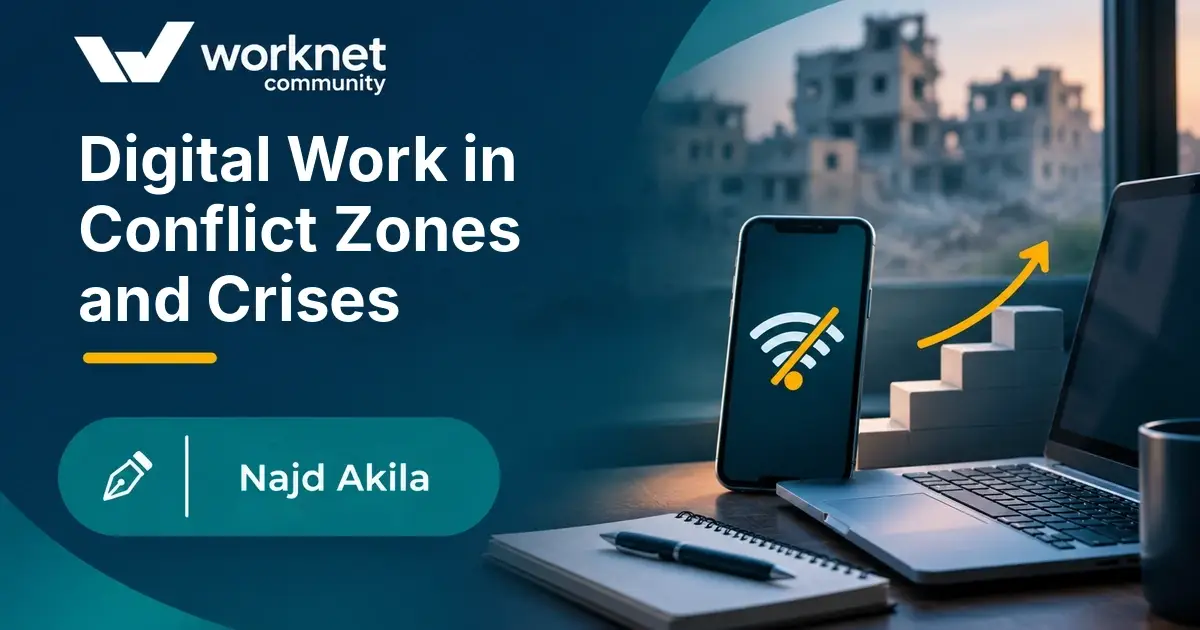
Digital and remote work have become important options for people who want to reach professional opportunities beyond their immediate geography, especially during conflict, displacement, and economic and humanitarian crises.
While traditional jobs are disrupted by unstable markets, institutions that stop functioning and difficult movement, digital tools can make it possible to continue some work and services online, depending on the resources and conditions available.
That said, digital work in conflict zones is not free of difficulty. Workers face internet and power outages, unstable housing, psychological strain, and trouble reaching clients and receiving payment.
In this article we look at what digital work means in conflict and displacement settings, the main challenges workers face, the skills that matter, and practical strategies for continuing to work remotely under difficult conditions.
What Is Digital Work in Conflict and Displacement Settings?
Digital work means carrying out professional tasks and delivering services through the internet and technology tools. It includes remote employment with companies and organizations, freelancing, and running online projects and stores.
This kind of work matters even more in places affected by conflict and displacement, because it can open access to clients and markets outside the area where a person lives, and reduce the need for daily travel or constant presence at a workplace.
Common fields of digital work that can be done remotely include:
- Digital marketing: managing social media accounts, preparing ad campaigns, and analyzing marketing performance.
- Search engine optimization (SEO): optimizing website content, researching keywords, and improving how pages appear in search results.
- Content writing: producing articles, blog posts, and marketing content that fits audience needs.
- Graphic design: designing posts, ads, and visual materials for brands.
- Programming and web development: building, maintaining, and extending websites and applications.
- Customer service and virtual assistance: organizing administrative tasks, answering inquiries, and following up on daily operations.
- E-commerce management: updating products, managing content, tracking orders, and improving the user experience.
The right field depends on the skills a person already has, their access to devices and the internet, demand in the job market, and how well the work fits their circumstances.
The Main Challenges of Digital Work in Conflict Zones and Crises
Despite the opportunities digital work offers, working remotely in crisis areas is different from working in stable environments. Conditions on the ground can directly affect productivity, deadlines, and the continuity of income.
1. Internet and Power Outages
Power cuts and weak internet connections are among the biggest challenges for digital workers in conflict-affected areas. A dropped connection in the middle of a meeting, a task or a file upload can halt work and delay delivery.
Some practical steps can reduce the impact:
- Download files, learning materials, and essential tools in advance.
- Keep copies of important files on the device so they can be worked on offline.
- Use lightweight tools that consume less data whenever possible.
- Keep backups of key projects and files.
- Agree with clients on realistic deadlines that allow for connection interruptions.
These measures do not remove the effect of weak infrastructure, but they can reduce lost time and help make the most of the hours when power and internet are available.
- Download files and tools in advance
- Keep backups of key files
- Agree realistic deadlines
- Do tasks that need no internet
- Work on files saved on your device
- Use lightweight tools
- Make the most of the hours you are online
- Deliver the files
- Update the client on any date changes
2. Displacement and an Unstable Workplace
Workers may have to move between places because of security or humanitarian conditions, which makes it hard to keep a stable working environment.
Frequent moves can also affect access to devices, connection speed, privacy, and the ability to attend virtual meetings.
It therefore helps to organize work files so they can be reached from different devices, to use reliable cloud storage when it is safe and available, and to keep local copies of important files.
It is also important not to depend entirely on a single device or a single way of connecting, and to put personal safety ahead of any professional commitment.
3. Psychological Pressure and Difficulty Concentrating
The effects of conflict and crisis are not limited to infrastructure and the economy. They reach daily life, the ability to concentrate, and time management.
A worker may struggle to keep a fixed schedule because of worry about family, changing living arrangements, or personal responsibilities overlapping with work tasks.
In these cases, organizing work flexibly can ease the pressure: breaking projects into small tasks, setting daily priorities, and doing the work that needs more focus during the most suitable hours.
Professional expectations should also be realistic, and workers should be given room to communicate with clients when circumstances are beyond their control. Lower productivity during a crisis does not necessarily mean a lack of skill or competence.
4. Difficulty Reaching Clients and Receiving Payment
Some freelancers in conflict zones face challenges with creating accounts on freelance platforms, verifying their identity, and having access to payment methods and money transfers.
Geographic or financial restrictions can limit the ability to use some platforms and services, even when the worker has the required skills. A joint study by UNDP, the ILO and UNHCR indicates that the requirement for an approved identity document for registration and verification, and anti-money-laundering rules for opening bank accounts and receiving transfers, are among the main barriers for refugees and host communities, and that currency-conversion fees can take a large share of earnings in some countries (1).
It is therefore advisable to check each platform’s registration and withdrawal conditions before relying on it, to agree clearly on the scope, cost, and delivery dates of the work, and to use reliable and legally available payment methods. For specific examples, see our article on financial withdrawal challenges for remote workers in conflict zones.
Be careful, too, with fake job offers that ask for upfront fees or sensitive personal and financial information in exchange for promises of employment or guaranteed profits (2) and (3).
How Can You Start Digital Work Under Difficult Conditions?
A digital career can be built gradually even with limited resources, by focusing on skills that can be developed, showing that you can deliver tasks, and looking for opportunities that suit your circumstances.
First: Choose an In-Demand Digital Skill
The first step is to pick one field you can learn or develop with your current means.
For example, someone with writing skills can start with content writing and SEO, while someone interested in design can learn to prepare visual materials and digital ads. Someone with a technical background can build their skills in programming or technical support.
It is best to start with a specific field, learn what clients actually ask for, and then deepen your knowledge gradually rather than spreading yourself across many specializations.
Second: Build a Professional Portfolio
A portfolio shows your skills in practice, especially when professional experience is limited or first opportunities are hard to find.
You can create sample projects that do not require a real client, such as:
- Writing an article that follows SEO best practices.
- Preparing a monthly content plan for a fictional brand.
- Designing a set of posts for a marketing campaign.
- Building a sample web page.
- Preparing a simple performance report for an ad campaign.
It is a good idea to explain the goal of each project, the skills it shows, and the tools used, while clearly distinguishing practice projects from work done for real clients.
Third: Look for Remote and Freelance Opportunities
Freelance and remote hiring platforms make it possible to reach project owners and companies in different markets.
You can start with small projects that match your current skills, then build experience gradually by improving the quality of your work, building professional relationships, and earning trustworthy reviews where the nature of the work allows.
It is essential to review each platform’s terms, to confirm that it can be used in your country of residence, that suitable payment methods are available, and to follow its communication and contracting policies.
It is not advisable to rely on a single platform or a single source of clients when reliable alternatives are available.
Fourth: Manage Your Time Flexibly
A fixed work schedule may not be possible in crisis settings, so a flexible approach to managing tasks can help.
This includes identifying the most important tasks, breaking large projects into short steps, making use of the periods when a connection is available, and preparing a list of tasks that can be done without the internet.
Letting clients know early about any expected delay also helps preserve trust and reduce misunderstandings.
Fifth: Develop Professional Communication Skills
Success in digital work does not depend on technical skills alone. Clear communication, managing client expectations, and meeting agreed deadlines are essential to building lasting professional relationships.
It is useful to learn how to write service proposals, define the scope of a project, document agreements, and explain challenges that may affect delivery in a professional and concise way.
These skills matter even more when a team works remotely and its members cannot stay in constant contact because of the circumstances around them.
The Role of Digital Work in Supporting Communities Affected by Crises
Digital work can provide professional opportunities for people affected by conflict and displacement, help them keep their skills and experience, and give them access to markets beyond their local area (1).
Small organizations and community initiatives can also use digital tools to continue some of their activities, such as communicating with audiences, managing content, delivering services online, and organizing administrative operations.
In addition, remote work may support the participation of people whose circumstances limit their ability to travel or reach traditional workplaces.
It is important, however, not to overstate these opportunities. Digital work is not a comprehensive substitute for humanitarian aid, economic recovery, or basic infrastructure. Access to digital jobs is also not equal for everyone, because of differences in capacity, connectivity, training, and financial resources (1).
Digital work should therefore be seen as one of the paths that may support professional and economic stability, not as a single solution to all the challenges of a crisis.
How Can Organizations Support Digital Workers in Crisis Areas?
Keeping remote work going in unstable environments takes cooperation between workers, project owners, and organizations, bearing in mind that conditions on the ground may make conventional work procedures impractical.
Practices that can support workers include:
- Flexible working hours: adopting schedules and deadlines that allow for connection interruptions and changing circumstances.
- Clear priorities: focusing on essential tasks and reducing unnecessary meetings.
- Alternative ways to communicate: agreeing in advance on other ways to communicate and deliver files when the usual channels are unavailable.
- Evaluating results objectively: looking at the quality of work and agreed outcomes instead of requiring constant online presence.
- Clear financial terms: setting the payment amount, method, and timing from the start of the collaboration.
- Respecting privacy and safety: not asking workers to share their exact location or sensitive information that the work does not require.
- Appropriate support: leaving room to negotiate priorities and deadlines when exceptional circumstances affect the ability to deliver.
A flexible digital work environment does not only support workers. It can also help organizations retain expertise and keep collaboration going as circumstances change.
Digital Security and Data Protection While Working in Crises
Digital security matters even more when people rely on the internet to run their work and communicate with clients, especially where connection and living conditions keep changing.
Several basic practices can strengthen the protection of accounts and professional files:
- Use strong, unique passwords for important accounts.
- Enable multi-factor authentication wherever it is available and safe to use.
- Update operating systems and applications regularly when conditions allow.
- Keep backups of important files in a secure place.
- Verify the identity of clients and the links they send before opening files or sharing information.
- Avoid untrusted networks and devices when accessing sensitive accounts.
- Limit the sharing of personal documents and information about your location or personal circumstances to what is necessary.
Keep in mind that cloud storage is not completely secure. Choose suitable services, secure your accounts, and consider how sensitive a file is before uploading or sharing it.
Most importantly, personal safety and basic needs remain the priority. Digital work is a way to support professional stability, not a reason to take unnecessary risks or accept commitments beyond what is realistically possible.
The Future of Digital Work in Conflict and Displacement Settings
The future of digital work in conflict and displacement settings depends on how well individuals and organizations can adapt to technological change. It also depends on basic factors such as the availability of internet, electricity, and devices, access to training, and the availability of fair job opportunities and suitable payment methods.
It is important for educational institutions, the private sector, and community organizations to work together on training programs that respond to real labor-market needs, help people acquire applicable skills, build portfolios, and learn about employment and freelance opportunities.
Expanding access to digital infrastructure can also help reduce some of the barriers that limit people’s participation in the digital economy.
In this context, the success of a worker in difficult circumstances should not be measured by output alone, but also by their ability to adapt, to maintain their skills, to develop their experience, and to make use of the opportunities available within their resources and circumstances.
Conclusion
Digital work in conflict zones and crises can be a real opportunity to maintain professional continuity, reach new markets, and develop skills, especially when some forms of traditional work are disrupted or out of reach.
However, making the most of remote work under difficult conditions takes more than technical skills. It needs flexible time management, realistic planning, data protection, reliable ways to communicate and get paid, and institutional support that takes humanitarian and economic challenges into account.
Building a digital career in an unstable environment can be a gradual process with difficulties and interruptions along the way. Still, developing skills, preparing for changing conditions, and making use of the opportunities available can help open new professional paths, step by step, within the means available. If you want to develop your skills, explore the workshops and training paths available through the WorkNet Learning Hub.
Frequently Asked Questions About Digital Work in Difficult Conditions
Can you work online from conflict zones?
Yes, some people can work online from conflict zones, depending on the availability of electricity, connectivity, and devices, and on access to work platforms and payment methods. Opportunities vary from one area to another depending on technical, security, and economic conditions.
What are the best digital skills to learn under difficult conditions?
Options include content writing, search engine optimization (SEO), graphic design, social media management, programming, and virtual assistance. The most suitable field depends on current skills, available time, and market needs.
How can you keep working remotely when the internet goes down?
You can prepare in advance by downloading essential files, lining up tasks that do not need an internet connection, keeping backups of projects, and getting back in touch with clients once the connection returns to update them on any changes to delivery dates.
Does digital work provide a stable income in times of crisis?
Digital work does not guarantee a stable or immediate income. Results depend on skills, experience, demand for services, and access to clients and payment methods. It is therefore important to assess opportunities carefully and not to rely on promises of guaranteed profits.
How can organizations help remote workers in crisis areas?
Organizations can support them by offering flexible working hours, setting clear priorities, providing alternative ways to communicate, putting transparent financial arrangements in place, and taking into account circumstances beyond workers’ control, while respecting their privacy and safety.
Trusted Sources for Further Reading
To learn more about digital work and decent work in crisis-affected settings, you can consult the following sources:
- (1) UNDP, ILO and UNHCR, 2024: Emerging practices to improve access to and working conditions on digital labour platforms for refugees and host communities
- (2) ILO, 4 October 2023: Digital risks: safeguarding refugees and host communities in accessing online services, learning and job opportunities
- (3) ILO, 2016: ILO’s 2016 General Principles and Operational Guidelines for Fair Recruitment
- ILO, further reading: Digital labour platforms

A Palestinian freelancer working in voice-over, content and report writing, and proofreading.
Graduate of WorkNet’s SEO Training Program