When someone works remotely from a war zone, the work itself may be the easy part. The real difficulty starts after delivery: how does the money reach the person who earned it? Platforms that do not serve the region, banks that cannot open new accounts, scarce cash, and intermediaries who take a large share of the pay.
In this article we review what research reports and news organisations have documented about Gaza, Sudan and Syria, identify where the money gets stuck, set out the workarounds people use and the risks of each, and suggest practical steps to prepare.
Where does the money get stuck?
A payment passes through three stages before it becomes cash or a balance you can spend, and it can stall at any of them:
| Stage | What can go wrong | Documented example |
|---|---|---|
| Platform or payment method | The region is not served, the account is closed, identity cannot be verified | PayPal does not serve Palestinians in Gaza and the West Bank |
| Bank account | New accounts cannot be opened, or the bank cannot be reached | Palestinian banks could not open new accounts during the war |
| Local cash | Cash shortages, commissions to convert a balance to cash, banking apps going offline | A commission of up to 25% to convert a Bankak balance to cash in Sudan |
Gaza: blocked platforms and heavy commissions
Three problems recur in reports on Gaza: platforms that do not serve the region, accounts that get closed, and heavy commissions to turn a balance into cash.
Platforms and payment methods
- PayPal, which operates in about 200 countries, does not serve Palestinians in Gaza and the West Bank, and about 80% of Palestinian households would use it if they could (Atlantic Council, September 2026).
- In 2021 rights groups launched a campaign to end the exclusion. Palestinian freelancers said some accounts were closed or funds frozen, and many relied on alternatives such as Payoneer (Al Jazeera).
- Payoneer, Wise, Revolut and Stripe are reachable in principle, but workers faced account closures triggered by IP detection, failed identity verification, and an inability to withdraw in the case of Wise and Revolut.
- Payoneer requires a linked bank account, which was impossible when Palestinian banks could not open new accounts during the war.
How much of the pay is lost?
| Item | Share | Source |
|---|---|---|
| Upwork commission (per the Atlantic Council; Upwork’s own page states 0–15% per contract) | 10% | Atlantic Council |
| Currency-exchange and informal intermediary losses, regardless of platform | 20–30% | Atlantic Council |
| Converting bank transfers to cash in Gaza (“cash-out”) | From 5% early in the war to about 50% at times in 2025 | Al Jazeera |
| Converting a Bankak balance to cash in Sudan while the RSF controlled Khartoum | Up to 25% | Agence France-Presse |
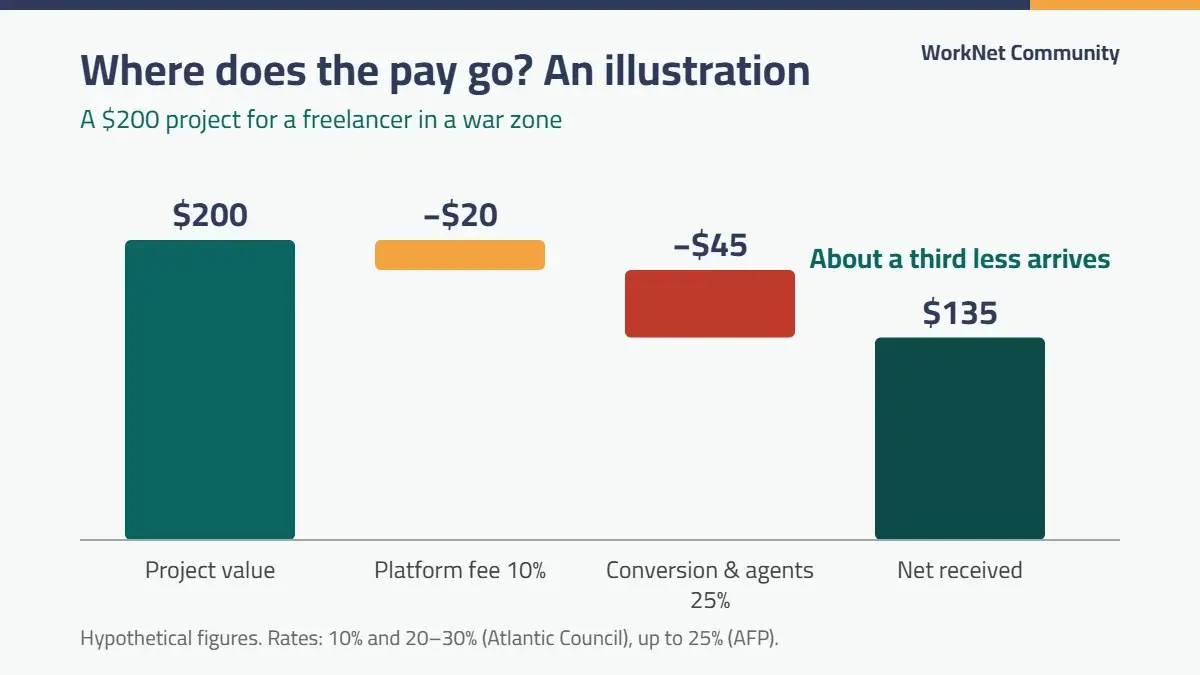
An illustrative example with hypothetical figures: a freelancer delivers a $200 project. After the platform commission (10%) $180 remains, and if 25% is lost to conversion and intermediaries the net is $135, roughly a third less.
“Cash-out”: turning a balance into cash
- It started at a deduction of about 5% early in the war and reached about 50% at times in 2025. One example: a person lost $350 of the $1,000 that reached their account (Al Jazeera Arabic, September 2025).
- In May 2026 the commission for getting cash reached 17–19% in some transactions and fell to about 2% after the switch to bank transfers, according to the director of a local foundation (Al Jazeera Arabic).
- In August 2026: some banks scrutinise incoming transfers and ask for proof of the type of service, the source of funds and the reason for the transfer (Al Jazeera Arabic).
- More than 50 bank branches were destroyed according to the Palestine Monetary Authority, and people holding replacement IDs issued after 2023 struggle to open new accounts (Al Jazeera English, 28 August 2026).
Local initiatives
- Freelanceo: the client pays by credit card and the freelancer receives money through a Palestinian bank with no commission within 24 hours (Atlantic Council).
- Gaza Talents: connected workers in Gaza with international clients and helped generate more than $600,000 in income, working with the Bank of Palestine and the PalPay wallet (AP).
- PalPay handles shekel payments and cannot receive payments from abroad (Atlantic Council).
Sudan: a collapsed banking system
The banking system has collapsed, and with it the simplest ways of receiving pay.
- The Central Bank in Khartoum, connected to the SWIFT network, was set on fire and then occupied by fighters for nearly two years, and many banks are closed or looted (AFP, December 2025).
- A civil servant had not held a banknote in more than nine months, and the black-market rate rose from 450 Sudanese pounds to the euro to 3,500.
- Before the war only about 15% of adults had a bank account (World Bank), so many relied on the Bankak app of the Bank of Khartoum.
- In May 2023 Bankak went offline for days in a row, disrupting remittances from abroad and everyday payments (The New Arab).
- The RSF took a commission of up to 25% to convert a Bankak balance into cash while it controlled Khartoum (AFP).
Syria: restrictions easing, but the payments system is unfinished
The door has opened partly after years of financial isolation, but the withdrawal path is not clear yet.
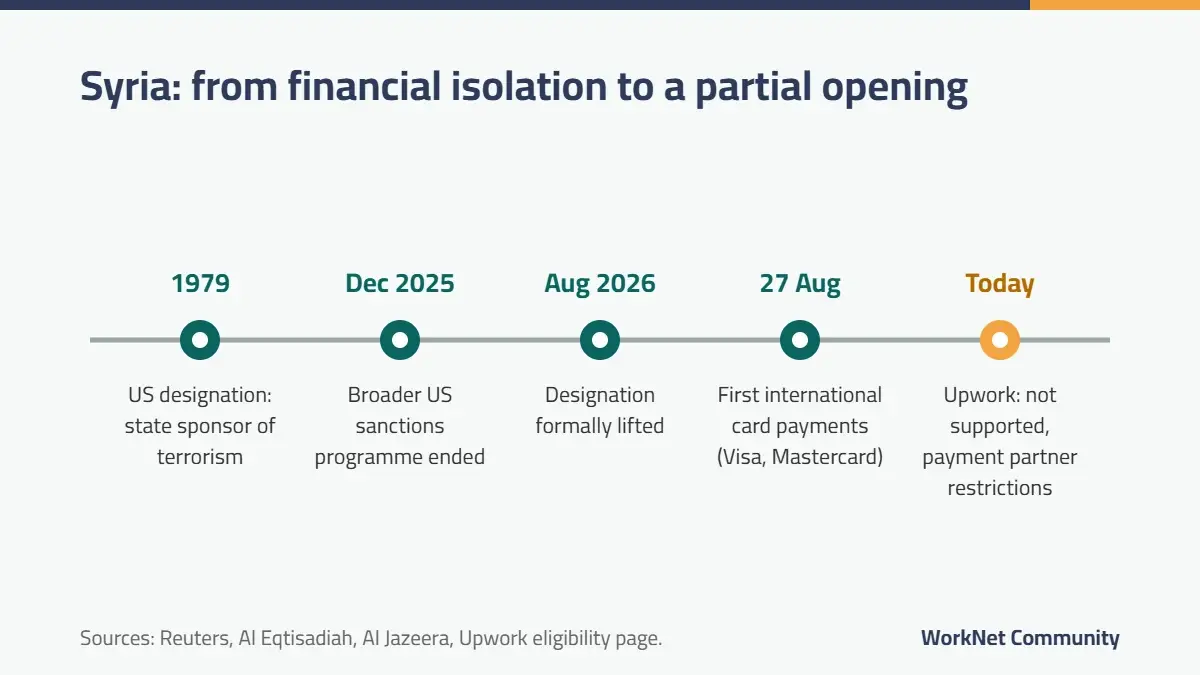
- For years Syria was outside global payment networks. The US designation, in place since 1979, deterred international banks and investors even after the broader sanctions programme ended in December 2025 (Reuters).
- In late August 2026, days after the designation was lifted, the first international card payments were announced through Visa and Mastercard, the first in more than 15 years (Al Eqtisadiah).
- But the central bank says the service has not reached nationwide coverage, Mastercard acceptance is being added gradually pending approvals, Visa is still a test, and rebuilding correspondent banking relationships has no timetable (Reuters).
- Sending money from abroad often still goes through Lebanon or Turkey, and some online services may require a VPN (Al Jazeera, July 2026).
- For a Syrian freelancer: check that the platform supports your country before signing up, and avoid registering with an address that does not match where you live, since the Atlantic Council notes IP detection can lead to account closure.
Internet and electricity: the condition for reaching your money
Even where a payment channel exists, a freelancer needs connectivity and power to use it. In Gaza, according to the Atlantic Council:
- 64% of mobile towers were out of service in April 2025.
- The territory remains limited to 2G service.
- More than 70% of ICT assets were damaged or destroyed.
A simple withdrawal can become a difficult task in itself. To see how workers keep going despite outages, read our article on digital work in conflict zones and crises.
What do the platforms say, and do their policies change?
What Upwork states officially on its pages:
- It serves freelancers in more than 180 countries and is not available everywhere.
- US law bars it from doing business with people located or travelling in restricted areas, including Iran, North Korea, Cuba, Crimea and the Luhansk and Donetsk regions, plus any country or region restricted by law (the list can change). Gaza and Sudan are not named.
- Syria: no longer comprehensively sanctioned by the US, but not currently supported by Upwork because of payment partner restrictions. Lifting sanctions does not automatically restore a platform.
- The beneficiary name on a withdrawal method must match your verified name, a withdrawal cannot be cancelled once started, and funds sent to an invalid or closed account usually return within 4 to 8 business days. Using someone else’s account to withdraw Upwork earnings conflicts with this rule.
Do the policies change?
| Change | Details |
|---|---|
| Suspending operations in Russia and Belarus | From 1 May 2022, because of the war in Ukraine |
| Fee for withdrawing to a US bank | Free for freelancers with a US tax address, and $2.99 for an international tax address from 1 September 2026 |
| Other methods today | $0.99 for a direct transfer to a local bank outside the US and $50 for a US-dollar wire; Payoneer and PayPal are available |
| A new withdrawal method | Becomes active after a three-calendar-day security hold |
In the pages we reviewed, Upwork does not comment on the causes of difficulties in specific regions or on the effect of war on withdrawals, so the above is its stated policy, not an explanation of particular cases. The page itself notes that withdrawal options may change over time, so check the official support pages before any decision.
Common workarounds and their risks
The sources record a range of workarounds. The table compares them, with a warning that some carry real risks:
| Workaround | What it offers | Risks |
|---|---|---|
| Receiving pay through a relative abroad | Bypasses regional restrictions | Relies entirely on trust, with no guarantee for the freelancer if the money is lost, and it conflicts with Upwork’s name-matching rule for withdrawals |
| Cash brokers who accept electronic transfers | Provide cash inside the region | High fees |
| Western Union and MoneyGram | Well-known transfer channels | Need a nearby branch or agent, and fees apply |
| USDT digital currency | Relatively fast transfers | Needs an intermediary to convert to cash, legal treatment differs between countries, and scams are common |
| A US company set up through Stripe Atlas | Provides an account and international payment tools | Set-up costs and legal and tax obligations |
| Local platforms and programmes such as Freelanceo and Gaza Talents | Payment through a local bank at low or no commission | Serve a limited number of workers |
We do not recommend any workaround that relies on impersonating someone or using another person’s account. According to the same brief, accounts are closed when identity checks fail or the IP address does not match, and losing an account means losing the balance inside it.
How to prepare
These are general practical tips, not drawn from the sources above:
- Open your accounts and complete identity verification early, before you need the money, and with accurate information.
- Do not rely on a single withdrawal channel. Prepare at least two and test each with a small amount first.
- Calculate the full cost before accepting a project: platform commission, currency difference and intermediary fee.
- Ask the client for milestone payments instead of one lump sum at the end, so less money is stuck if a channel fails.
- Withdraw your earnings whenever you have a safe connection rather than leaving a large balance on the platform for long.
- Keep a record of invoices and transfers, as you may need it to prove your income source to a bank or platform.
- Prepare backups for power and connectivity (a spare charger, a second SIM) for important withdrawal dates.
The role of training programmes and funders
Skills alone are not enough. A trainee who learns an in-demand profession but does not know how to receive payment will struggle. Remote-work training and employment programmes should therefore include guidance on the payment channels available in the trainee’s country, and funders should check channels such as local bank transfers before a programme starts. The Atlantic Council brief treats payments as part of rebuilding Gaza’s remote-work sector.
Frequently asked questions
Why does PayPal not serve some regions?
According to Al Jazeera in 2021, PayPal said it does not operate in 30 countries it classes as high risk, including Palestine, and Al Jazeera noted that it does serve Yemen. Platform policies change, so check the current position in your country before signing up.
Can I rely on cryptocurrency?
The sources list USDT among the workarounds in use, but it needs an intermediary to convert to cash and the legal position differs between countries. Understand its legal status where you live and do not use it without enough knowledge.
What is the best way to protect my earnings?
No single approach suits everyone, but diversifying withdrawal channels, asking for staged payments and calculating the full cost before you sign are what most reduce losses.
Has Upwork said why withdrawals are hard in war zones?
In the official pages we reviewed, Upwork explains its restrictions by legal grounds (US law) and, for Syria, by payment partner restrictions. We found no statement from it about Gaza, Sudan or the effect of war on withdrawals. If you have a problem, contact Upwork support formally.
Does easing restrictions on Syria mean withdrawals are now easy?
Not yet. According to Reuters, the launch of international card services has not reached nationwide coverage, and the central bank is still rebuilding correspondent banking relationships. Follow announcements from the platform you work with and check directly before making any decision.
Summary
The problem is not the work but the path the money takes: platforms that do not serve the region, disrupted banks, and costs that can swallow between 10% and a third of the pay. Planning ahead and diversifying channels reduce the loss, and local initiatives remain an important part of the solution. In Syria, although restrictions are easing, the payments system is not yet complete. To learn how to raise the value of your work in the first place, read Freelancing and AI Tools.
Sources
- Atlantic Council, Avia Liberman and Melanie Robbins, “What it will take to rebuild Gaza’s remote-work sector” (1 September 2026)
- Associated Press (AP) via Gulf News, Gaza’s digital workers through blackouts and bank restrictions (14 May 2026)
- Al Jazeera, “Rights groups to PayPal: End discrimination against Palestinians” (7 October 2021)
- Agence France-Presse (AFP) via Gulf News, “With no cash, Sudanese turn to barter and credit” (last updated 1 December 2025)
- The New Arab, “Sudan banking app goes offline, leaving millions stranded and hungry” (12 May 2023)
- Reuters, “Visa, Mastercard launch international card payments in Syria after US lifts terrorism designation” (27 August 2026)
- Al Eqtisadiah, first electronic payment with an international card in Syria (27 August 2026)
- Al Jazeera, “Syrians optimistic but cautious as sanctions removal revives economic hopes” (11 July 2026)
- Al Jazeera (Arabic), Mohammed Abu Qamar, report on “cash-out” and remittances in Gaza losing half their value (26 September 2025)
- Al Jazeera (Arabic), Gazans’ struggle to turn money into a loaf of bread (10 May 2026)
- Al Jazeera (Arabic), remote work as an income source for thousands of Gazans (6 August 2026)
- Al Jazeera English, “Gaza forced to use unreliable online payments amid ‘cash famine’” (28 August 2026)
- Upwork support page, “Who’s eligible to join and use Upwork?” (accessed October 2026)
- Upwork support page, “How to get paid on Upwork” (accessed October 2026)